The what if disasters Vehicles system is mainly about choosing a route quickly. Cars and other land vehicles can move you while roads remain usable, while boats can become the better option when water covers the normal path. Treat every vehicle as temporary mobility rather than a guaranteed shelter: the disaster, terrain, and other players can make a vehicle unusable without warning. Before committing to a route, check the maps guide for landmark and terrain cues.
Which vehicle should you use?
Choose based on the surface ahead, not on the vehicle's name. The available vehicle depends on the map and scenario, and the available evidence does not establish fixed speed, durability, seating, or control values for individual vehicle types.
| Vehicle | Best use | What you need | Main risk |
|---|---|---|---|
| Car | Fast movement on passable roads and ground | A spawned car and an open land route | Difficult steering, collisions, getting stuck, or sinking when water takes the route |
| Police Car | Road movement when a police car is available | A spawned police car | Its speed and durability are not documented; it can still be exposed to the disaster |
| Truck | Crossing ground areas while the route remains open | A spawned truck | Collision or destruction; do not assume extra disaster resistance |
| School Bus | Moving along a road or using a large vehicle as a temporary position | A spawned school bus | It is not confirmed to be safe in every disaster |
| Boat | Moving across usable water during flooding or a water route | A spawned boat and passable water | Waves, rising water, difficult boarding, and changing water routes |
| Snowmobile | Moving through a snowy or cold area | A spawned snowmobile in the relevant scene | Controls, speed, and cold resistance are not documented |
| Train | Scene transportation or a landmark | Map generation only | It is not a confirmed drivable vehicle |
Use the table as a route decision, not a ranking. Cars, Police Cars, Trucks, and School Buses need usable ground. A Boat needs water that can actually be crossed. A Snowmobile is only a potential option when the relevant scene provides one; its controls and performance are not established. A Train should not be part of your escape plan because it is presented as non-drivable.
How to find and use vehicles
Vehicles are not guaranteed to appear in one fixed location. After a scenario rotation, scan the areas where a map naturally places transport: parking areas, roads, bridges, riverbanks, and docks. When a vehicle is present, approach it and try to enter. Gameplay reports confirm that cars can be driven, but they also show that steering may be difficult and that vehicles can become stuck or collide with other players and terrain.
Step 1
Scan the route first: Look beyond the vehicle toward the next safe ground, building, bridge, or water crossing. Do not enter a vehicle without checking whether the route ends at fire, a broken surface, or rising water.
Step 2
Match the vehicle to the surface: Use a car, Police Car, Truck, or School Bus while ground remains open. Switch your plan to a Boat only when water is available and the boat can be boarded safely.
Step 3
Move before the hazard closes the route: Vehicles are most useful before flooding, fire, wind, infection, or terrain damage reaches the road. Keep enough distance from edges, bridges, and crowded areas to avoid being pushed or blocked.
Step 4
Leave the vehicle when it fails: If the vehicle is stuck, sinking, destroyed, or carrying you toward a worse hazard, abandon it and continue toward high ground, a building, or another safe position.
Vehicle safety during disasters
Use a vehicle to reach a safer position, then reassess. A car can help during a disaster when it provides a clear escape route, but it is not a substitute for high ground, an interior room, or a solid building. Fire, strong wind, extreme cold, explosions, falling debris, and floodwater can still reach the player inside or around the vehicle.
Water changes the decision fastest. During a flood or prolonged rain, a road vehicle may lose its route or sink, while a Boat may offer a workable escape across the water. That advantage is conditional: waves can push the boat, water levels can change, and jumping or fighting for a boarding position can kill the player. When the water route is unsafe, choose high ground or a building instead of forcing the crossing.
Choose a vehicle for the escape route
These moments support the guide's vehicle decisions by showing that trains are not drivable, cars can be difficult to control, and a boat can remain useful when cars sink during a water hazard.

Vehicle safety checklist
Before driving: Confirm that the ground ahead is open and that you have a fallback position.
Near water: Use a Boat only if it is available, the water is passable, and you can board without jumping into danger.
In a crowded area: Expect other players to occupy, push, or collide with vehicles; keep an alternate route.
When the route breaks: Leave a stuck or damaged vehicle and move toward high ground, a building, or another safe location.
What is not confirmed
The available vehicle records do not document fixed spawn points, key bindings, speed values, durability, seat counts, or disaster resistance for each vehicle. Police Car, Truck, School Bus, and Snowmobile sightings show that these vehicles can appear in gameplay, but they do not prove a universal function or stat line. A yellow bus shown on the Hoover Dam road is useful as a visual example of map traffic, not proof that every bus is drivable.
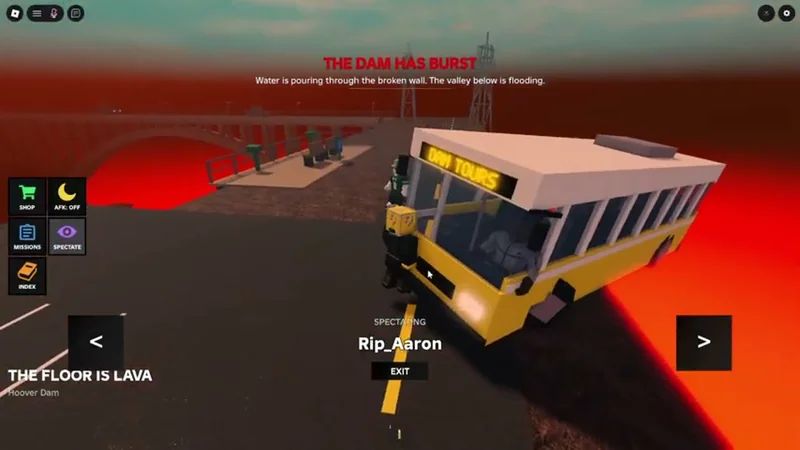
A yellow bus on the Hoover Dam road shows how vehicles may appear as map traffic, but does not prove that every bus is drivable.
The practical rule is therefore simple: use the vehicle that matches the route currently open in front of you, and keep a non-vehicle escape option. The game's in-round result—whether the vehicle can be entered, moves, floats, or reaches safety—takes priority over assumptions about the model.
SourcesReviewed October 27, 2026
https://what-if-disasters.wiki/maps
https://www.roblox.com/games/109440485612336/What-If-Disasters
https://www.youtube.com/watch?v=6Jli2JjPFyo
https://www.youtube.com/watch?v=EnH3oJAXyTs
The vehicle list and route guidance combine the What If Disasters maps reference with observed gameplay reports covering cars, Boats, Trucks, School Buses, Police Cars, Snowmobiles, and the non-drivable train. The reports show examples rather than a complete vehicle catalog. They establish that cars can be driven, that a Boat can be useful when cars sink during a water hazard, and that vehicles can be difficult to control or become stuck. They do not establish fixed spawns, controls, speed, durability, seating, or universal disaster protection. The in-game round remains decisive for availability and behavior.